

Week two of a six-week course, and an email lands at ten past ten at night. She has tried the practice four times and fallen asleep on every one of them, and she wants to know, as politely as anyone has ever asked you anything, whether she's doing it wrong or this simply isn't for her.
Then it happens twice more
You answer in the morning, carefully, with what you'd have said if she'd asked you in the room. It takes ten minutes to write and it's a good answer.
Nine days later the same question arrives from somebody else on the same course. Almost the same words, with the same small apology at the top of it, the one that says sorry, this is probably a silly question. You write back again, from scratch, because the first answer is somewhere in your sent items and it's quicker to type it out than to go looking.
The third one comes on a Sunday afternoon.
Now look at what you're holding. Three people on one course, stuck in the same week, all three convinced they're the only one. You're the only person alive who knows all three exist. Each of them is sitting with the private theory that everybody else is managing fine and she's the one who can't do the simple part, and that theory is wrong, and the evidence is in your inbox, and there is no way to hand it to them without breaking a confidence or sending a strange round-robin email about a problem two thirds of them don't have.
By week four, two of the three have stopped opening the lessons.
Two things before I go anywhere near what we sell. A room won't invent something for people to talk about, so if nothing is happening in your teaching the room stays empty, and an empty room is a worse advert than none at all. And we are a small, new company beside the places most practitioners put a group, which is fair to hold against us.
What those three emails cost you
Half an hour of your evenings, spread over a fortnight, is the cheap part.
The expensive part is that you said the same thing three times into three separate silences. Nothing you wrote could be read by anybody but the person who asked. The answer didn't accumulate anywhere. Next intake you'll write it a fourth time, and a fifth, each one slightly worse because you're tired of it by then.
The students paid more than you did. What makes somebody quit a course is hardly ever the material, and it is very often the quiet suspicion that they're behind everybody else. People stop in week two and three far more often than in week five, and why they stop is worth knowing on its own, because most of it hasn't much to do with how good the teaching was.
One answer, where everybody can see it
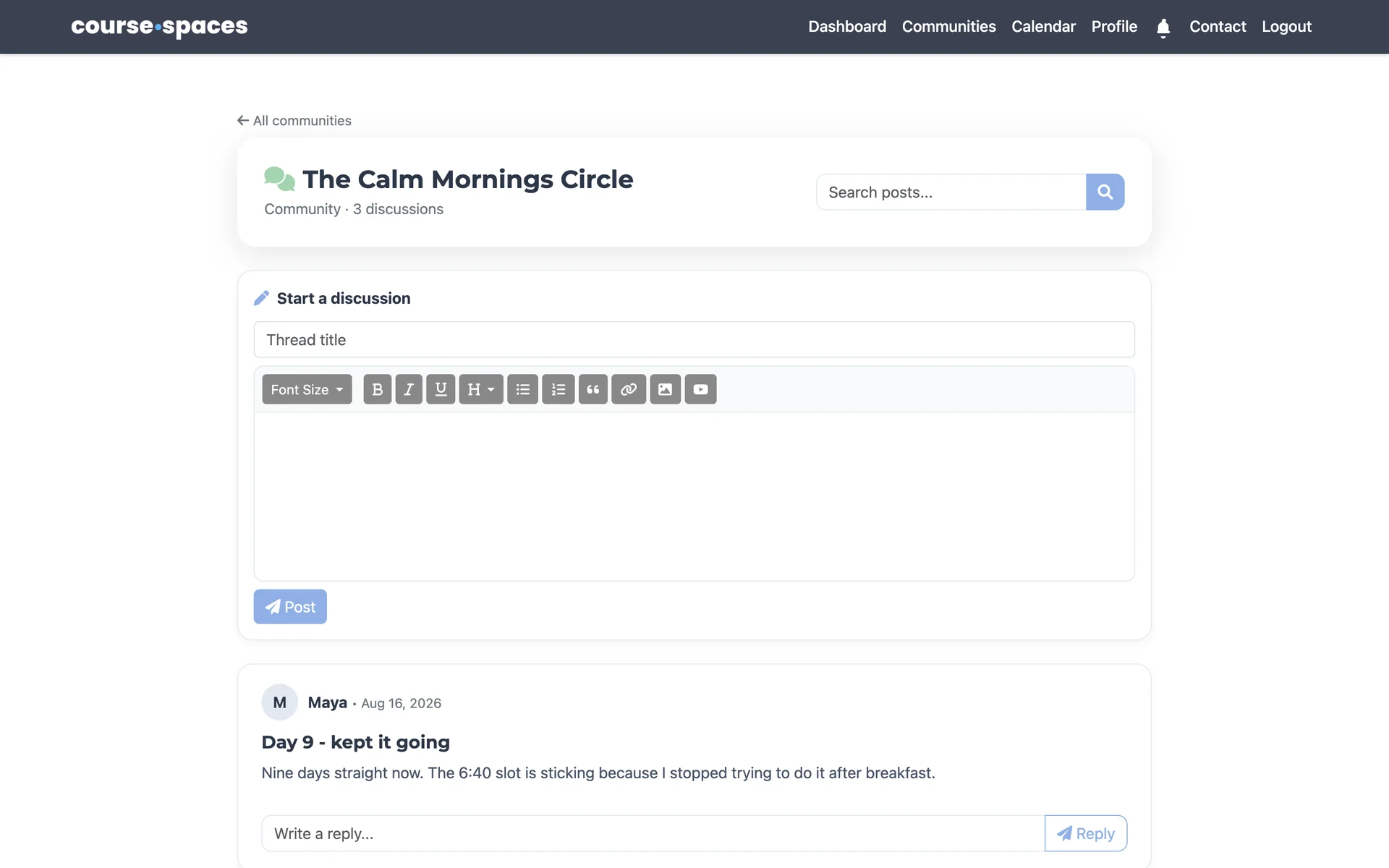
Put that question in a room the whole cohort can see, and three things change at once. Only one of them is about your time.
You answer once. It stays in the thread, and the person who hits the same wall in November reads it without asking.
The second student, drafting her apologetic email, sees the first one ask and learns something no message from you could teach her. She learns that she's normal. Reassurance from the teacher is kind and she'll half believe it. Reassurance from somebody two weeks in, stuck on the same step, is evidence.
Then sooner or later somebody answers before you do. That is the moment the whole thing turns from another job into something that pays you back, and it's usually a student on her second course with you, describing what worked in words you'd never have chosen.
People finish what they are doing beside somebody else

Think about why anybody turns up to a Tuesday evening class in February when it's raining and the car needs de-icing.
It isn't the material. They could get the material off a video for nothing. They come back because there's a spot on the floor that has become theirs, and because if they miss two weeks somebody will ask where they were, and because the woman who always sets up by the radiator has started saying hello. Move a class online and the material survives perfectly. Everything else gets left behind, and then everyone blames the format.
A course with a room attached puts some of that back. Not all of it. Nobody's passing you a cup of tea through a screen. But knowing one other name on the course, and being somewhere your own name is known, is most of what that Tuesday evening was doing.
One thing to expect, and it's nothing to do with any software: the most active thread in your group will be about something entirely beside the point. Where to get a bolster that doesn't collapse. Somebody's dog. Leave it completely alone. That thread is the group working.
The fourth time a question comes up, that is your next course

A room is also the cheapest research you'll ever do.
You already half know what people get stuck on. A group turns half knowing into a list, in their words rather than yours. When the same question appears for the fourth time, it isn't a nuisance and it isn't a gap in your teaching, it's a module. Sometimes it's a whole second course that a dozen people have asked you for.
It cuts the other way too, and this one stings. The section you were certain they'd need, the one that took two weekends to record, sits there all term and nobody mentions it.
Where your next students come from

Practitioners get students because somebody says a name out loud.
Not from an advert. Somebody at work mentions she's been doing a thing on Wednesday evenings, gets asked where, and says your name. That's always been how this works, and the only question is whether your students are ever in a position to do it. Somebody who took your course alone, finished it or didn't, and never met another soul, has a set of videos to describe. Somebody who spent six weeks in a room with eleven others has something with a shape and people in it, and that's the version that gets repeated by the kettle at work.
Finding the first handful of students is a separate piece of work with its own weeks in it, and I've written that out elsewhere. This page is about what happens after they arrive, which is the half that decides whether there's ever a next group.
Opening one takes about ten minutes

Communities sit on the same menu you use to add a lesson. Give it a name, decide whether new posts wait for your eye, and publish it. Your students don't join anything, don't make a second account and don't get a second password. They log in where the course already is, see your name and colours, and the room is there beside the lessons.
Rooms are unlimited, so one can belong to a single cohort instead of to everybody you have ever taught. If you already have a group somewhere else and what you want to know is why it went quiet, that's an argument I've made at length on its own page, and it's the other half of this one.
When not to open one
- You teach one to one and never two people at the same time. There's no cohort, so there's no room, only clients at eleven different stages who've never met. One to one chat is the right shape for that, and it's already there.
- You can't give it twenty minutes a week for the first couple of months. A new room needs somebody in it, and at the start that's you. If the next two months are already full, open it on the first day of the next intake.
- Your subject is one people won't put their name next to. A good deal of what practitioners teach is private enough that nobody posts about it in front of eleven others, however carefully it's moderated. If that's your work, the private word is the relationship, and a room adds nothing to it.
- Nothing is running until next year. A room with no cohort in it is a quiet room, and starting it today only means it's been quiet for four months by the time anybody walks in.
The rooms are not an extra

$47 a month, one plan. Unlimited communities and one to one chat are in it, alongside unlimited courses and products, 1,000 active students, hosted video with 1TB of bandwidth a month, the AI course builder, the AI assistant at 1,500 messages a month, a sales page, coupons and graded assignments. There's no tier where the group lives, because there's no second tier to move up to.
We take 0% of what you sell. You connect your own Stripe account and keep everything except Stripe's own 2.9% plus 30 cents, which everybody pays everywhere. The trial runs 30 days and doesn't ask for a card, and there's a 30-day money-back guarantee after it.
Take the cohort you're teaching right now. Open one room beside their course, and post the question that three of them emailed you about separately last time. Then sit on your hands and see who answers it.