

You know the room by now. You know roughly who comes on a Tuesday, you set out what you think you need, and then you stand there at two minutes past seven doing the arithmetic without meaning to.
The room decides your month, and you don't
You paid for the hall whether six came or twelve. The insurance came out on the first of the month either way. The drive was the same drive.
So the thing that sets your month isn't how well you teach. It's half term. It's a storm, a bug going round the primary school, somebody's daughter's wedding, and the fortnight in the year when everybody you know is away at once. It's the hall being given to a jumble sale that was booked in March. None of it is anything you did, none of it is anything you could have seen coming, and all of it lands on you anyway. It never settles into a number you can plan around either: a reasonable month, a thin one, another reasonable one, and by the time you've averaged it out in your head the year is over and you still couldn't have told anybody in advance what you earn.
Why you can never say no

The takings are the part you can count.
What wears people down is the other part. It's that you can never say no. A cover class at an awkward hour, a workshop you do not really want to run, a private client who drains you, and you take all of it, because a quiet week is always somewhere in the near future and you have learned to fear it. Saying yes to everything is not greed. It is what you do when nothing is predictable.
Then there's the teaching itself. When a quiet week costs you, a quiet week also stings, and it's hard to walk into a half-empty room and give the six people in it the class they deserve rather than the class you're worrying through.
Nobody puts that one in a spreadsheet.
For what it's worth, I think the wet Tuesday is often the best class you teach. Six people who came out in the rain are six people who genuinely wanted to be there. That doesn't pay for the hall, but it's true, and somebody should say it.
How small this is, before you give up any evenings

Here is the size of the thing. You take one sequence you already teach, the one your regulars keep asking you to write down, and you record it as four or five short lessons. That's a few evenings at the kitchen table with a phone on a tripod, or just your voice if what you teach is mostly you talking. Then you tell people it exists, more than once, which most teachers find harder than the recording.
Nothing sells itself because it's sitting there.
That's the whole first build. If you were hoping for something that runs without you, this isn't that, and the rest of this page will be a waste of your evening.
The part of your teaching that doesn't need a room

The class is the class. People come to it because you're standing in front of them, and no recording replaces that. What a recording does replace is [the eleven links you send afterwards](https://coursespaces.io/blog/can-you-send-me-last-weeks-class.html). What travels is the material around the class: the short course you've taught eleven times, the sequence everybody asks you to write down, the recordings of your own classes kept somewhere your regulars can reach them when they're away or ill or on a night shift. You can sell any of it once, or as a small monthly subscription. The subscription is the point of the exercise, because it renews itself whether or not anybody came out in the rain.
You connect your own Stripe account and the money arrives with you, less Stripe's own 2.9% plus 30 cents, which everybody pays everywhere. We take nothing on top of that.
Most teachers who come to us are already paying for something far bigger than they use, bought for one feature, with an email marketing suite and a funnel builder bolted to it that they have never once opened. Justine Lette at Hypnosis New Zealand was paying over $100 a month elsewhere and using a fraction of it. If it happens at that size, it happens to a Tuesday class.
What holds a small membership together
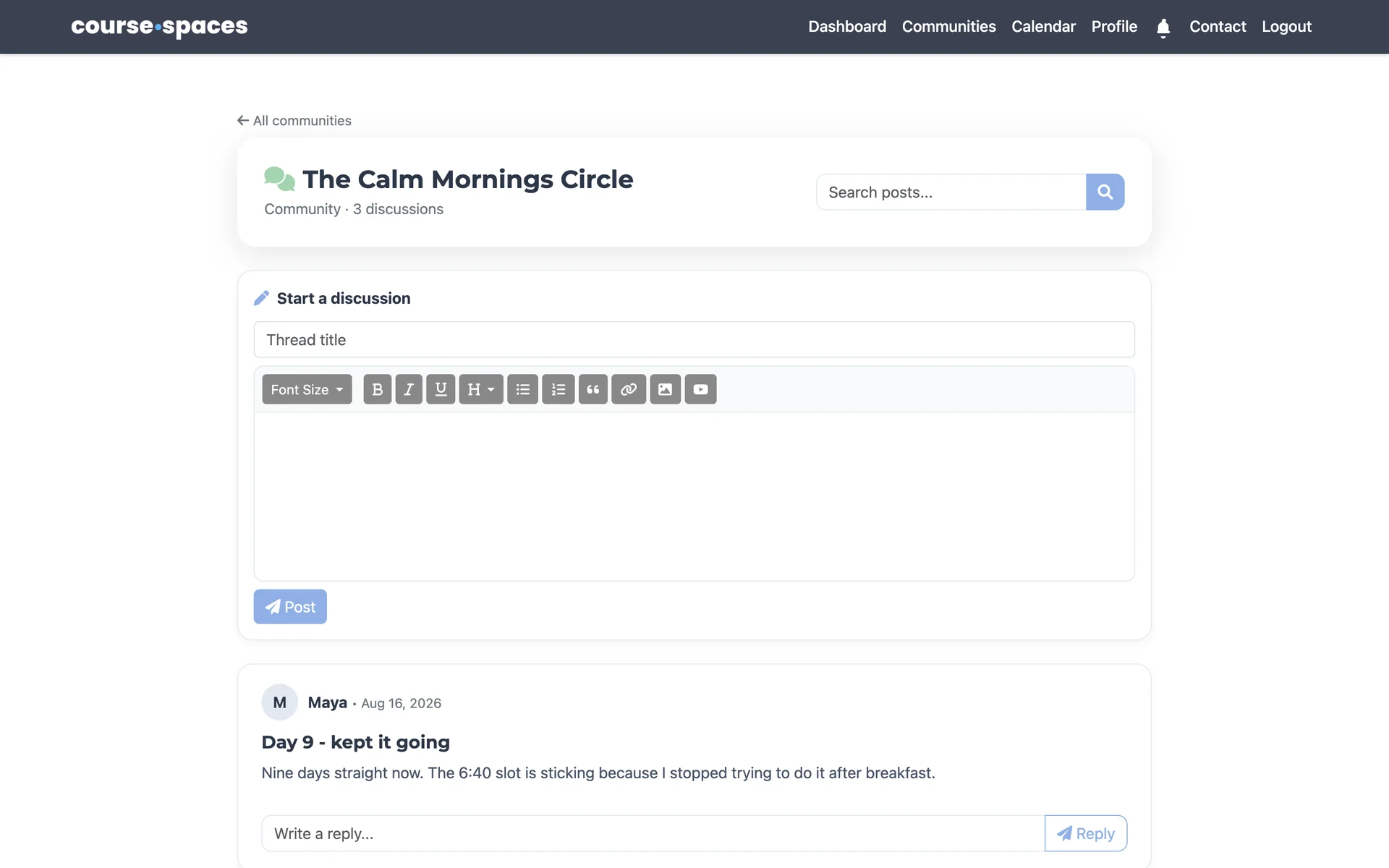
It doesn't have to be polished. What keeps people subscribed is usually the ordinary stuff: a handful of recordings, one short course, somewhere to ask you a question, and a live session in the calendar once a month so it doesn't feel like a video shop.
The place to ask you a question matters more than people expect. A group where your regulars talk to each other is the difference between a subscription somebody keeps and one they cancel in April.
Lessons can be video, audio, text, a PDF, a quiz, or a piece of work you mark. Nothing has to be filmed.
The arithmetic under a bad month

Here's the sum, and it is only a sum. Say thirty people come through your classes in a given month. You make one small membership for them, priced at $12, and six of them join. That's $72 a month that has nothing to do with the weather. Twelve of them is $144.
Neither of those numbers replaces a class, and I'm not going to pretend they do. What they change is the shape of a thin month. The week the storm shuts the hall, or the week half your regulars are away at once, the floor under you isn't zero, and you can turn down the cover class at the awkward hour without doing sums about it first.
I can't tell you how many would say yes, and anybody who quotes you a number for your own students is guessing. The ones most likely to are the ones already asking you for the sequence.
When we are the wrong tool
If you need a booking system, we're not it. We don't take bookings for your Tuesday hall class, we don't run a timetable, and we won't tell you who is coming tonight. This is for the part of your teaching that lives online. If the sign-up sheet is the thing driving you mad, buy a booking tool instead.
If you don't want to teach online. Plenty of very good teachers want to be in the room with people and nowhere else. That is a whole and complete way to work and it isn't something you are failing at.
If what you want is an audience of strangers. We give you somewhere to put the work and a page to sell it from. We don't bring traffic and we won't find you students. This works on the people already on your mats.
What it costs
$47 a month, one flat price, nothing to decode.
That covers unlimited courses and products, up to 1,000 active students, hosted video with a terabyte of bandwidth a month, the AI course builder, the AI assistant with 1,500 messages a month, unlimited communities and chat. The calendar, live sessions, daily check-in challenges, certificates on completion and marked assignments are included rather than an upgrade.
Extra video bandwidth, if you ever need it, is $10 per terabyte. There's a 30-day money-back guarantee.
Put $47 beside what the hall costs you for a month of Tuesdays. It's the same size of number, and this one doesn't stand empty when it rains.
Where to start
There's a 30-day free trial. It doesn't ask for a card, and nothing happens automatically when it runs out.
Don't try to move everything at once. Take the one sequence your regulars keep asking you to write down, and make that. Four or five lessons is plenty. Have it sitting there before the next stretch of bad weather does.