

That's almost never the thing that's missing. What's missing is duller and a great deal smaller: a list of names you're allowed to write to. The question underneath the software question is whether you can say one sentence to the people you already teach, on a day when you're not standing in front of them.
Wednesday, half past six, the same room since 2022
Twenty two mats when it's full, and most weeks it's full.
You know who has the bad knee. You know who comes in late from the school run and who will always take the spot by the radiator. You know which four people will still be standing by the door at half past eight talking about nothing.
Now try to send all of them a message.
You can't. Their names live in the studio's booking system. You see a class list on a tablet at the front desk twenty minutes before you teach, and that is the whole of your reach to people you have taught every week for four years.
The studio isn't being unkind
Worth saying early, because the thought sits there.
The studio found a lot of those people. They pay for the sign outside, the floor, the heating and the ads that filled the six thirty slot in January. The list is theirs because they built it, and most teaching contracts say so in writing. That's a normal arrangement and it isn't a scandal.
It still leaves you running something with no way of speaking to its own students. Both of those are true at once.
The week the timetable changes

The studio changes hands. The new owner brings two teachers with them. The six thirty moves to a Thursday you can't do, because you teach across town.
Nobody's cruel about it. You get four weeks' notice and a kind message. Then you teach a last Wednesday, say goodbye to the room, and the following week twenty two people arrive to find somebody else on the mat at the front. They'll ask where you went. The person at the desk will say they're not sure. That is four years of trust gone in a fortnight, and there was never a moment where you could have stopped it.
The same gap turns up on a good week. You decide to run your own six-week beginners course, or a Saturday workshop, or the retreat you've been sketching in a notebook since last winter. Then you sit down to tell people, and you're starting from nobody. Again.
Four situations where this isn't your move
Two of these are settled by reading a document rather than by buying anything.
Your contract says no. Plenty of them forbid this in plain words, and this page is not a loophole. Go and read yours. If it does, the route open to you is a conversation with the studio owner about a workshop of your own.
Everything you teach belongs to somebody else. No workshop, no private clients, no hall you've hired. Then a list has nowhere to come from this month and software isn't your first problem. Book a hall for one Saturday and come back after.
You want the students to arrive with the software. There's a public catalogue and people do browse it, and it's small. We're not going to describe it as a room of people waiting for you. Every name on your list will be there because of something you did.
You want your address on everything. You can point your own domain at your portal. What we do not offer is full white-label hosting, where every address a student sees is yours.
The list you're allowed to build
This is the part most advice skips, and it decides whether you still have work in six months.
Don't copy names off the tablet. Don't photograph the class list. Don't add the studio's students to anything of yours because you saw their details while teaching. If you aren't sure what your contract allows, ask the owner rather than guessing at it.
Your own student list is a different thing. It's made of people who chose to give you their name, for something that's yours. It grows far more slowly than the one on the tablet, and it doesn't vanish when a slot moves.
How it gets built, one person at a time

Out loud, at the end of class, in one sentence.
"I'm running a beginners course of my own after the break. If you want to know when it opens, put your name on the card by the door."
Then put a card by the door. Ask the studio first. Most will say yes to a poster for a workshop of your own, because a teacher whose people keep coming back is good for them too. Some will say no, and that's a fair answer.
An opinion nobody asked me for: index cards and a biro tied to the table leg with string work better than a QR code on a printed sign. I've no data for that and I'm not going to pretend otherwise. A stack of cards looks like a school jumble sale, and I suspect that's precisely why people write on it.
Six names on a Wednesday and four on a Saturday is forty people in a month. Forty people who asked to hear from you beats four hundred who were sold something once.
The ones who already said yes
You have more of these than you think, and they're scattered.
The register from the workshop you ran in the village hall. The people who paid a deposit for the retreat that got postponed. The ones who emailed asking about a private class. The replies to the message you sent when your Tuesday moved.
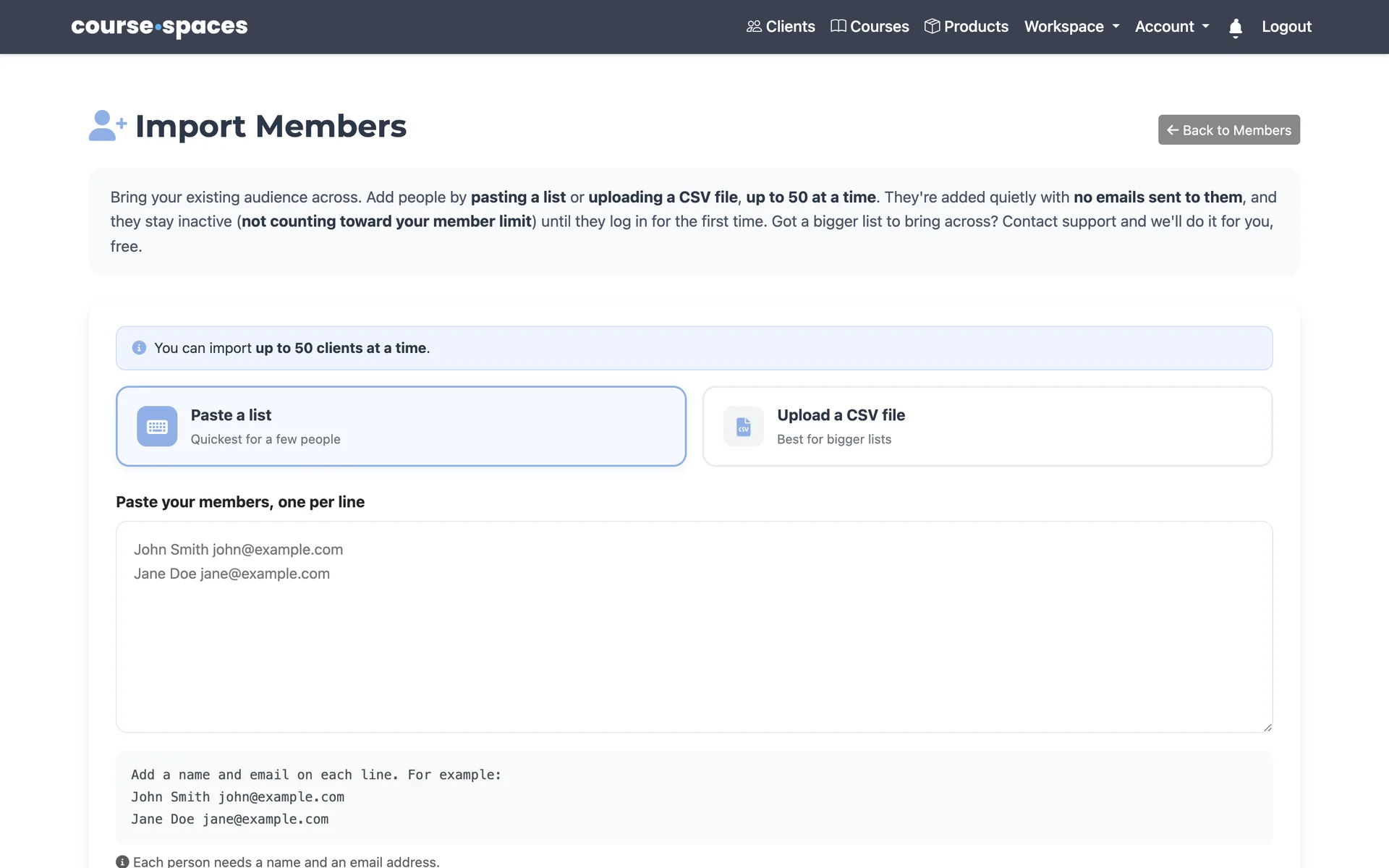
All of them chose to hear from you, which is the only kind that counts. You can paste them in as a list, or upload a spreadsheet, and everybody on it gets a login.
One rule that's ours as much as yours: only ever email people who asked. Not a list you bought, and not a list you copied off a desk. It protects your name long before it protects anybody else's.
Somewhere of your own to send them

At the moment, when somebody asks what else you do, the answer is a booking page with the studio's logo at the top.
A page of your own carries your name, your photograph, what you teach and what it costs. One link. You can say it out loud at the end of class, write it on the card by the door, and print it on the back of the workshop poster.
Justine Lette runs Hypnosis New Zealand, and she came across after paying over $100 a month for a platform she was using a fraction of. There are 3,670 students on CourseSpaces.
The Wednesday class stays in the room

Nothing here is about moving your teaching online. You teach in a room and that's the right place for it.
What can sit alongside it is the course you already teach. The six weeks you run at the same point every year, written down once, with the sequences and the short videos and the notes you currently repeat from memory in a car park. People who miss week three have it. People who move away keep it. People who aren't ready to walk into a studio can start with it and turn up in the room later. You write the thing once.
When those six weeks exist, the Wednesday regulars are the obvious people to hand them to, free if you want. You choose exactly who has it, and you can see everyone who does.
What nobody can tell you is how many of those cards turn into anything. We've never counted it, and anyone quoting you a rate for a biro and a stack of index cards has made it up. The part we'll stand behind is mechanical: the names sit on your list, in your account, and they don't move when a timetable does.
$47 a month, and the money lands with you
$47 a month. One price, no tier to work out.
That covers unlimited courses and products, up to 1,000 active students, hosted video with a terabyte of bandwidth a month, the AI course builder, the AI assistant with 1,500 messages a month, unlimited communities and chat. Your own page, the member import and the email broadcasts sit inside that rather than above it. Extra video bandwidth is $10 per terabyte, and six weeks of short videos won't get near it.
When somebody buys, the money moves through your own Stripe account and arrives with you. We take none of it. The only deduction is Stripe's own 2.9% plus 30 cents, which everybody pays everywhere.
There's a 30-day money-back guarantee, and a 30-day trial that doesn't ask for a card.
Where to start, this Wednesday

Don't move your teaching life anywhere. Put the card by the door, add the eleven people from the workshop you ran in March, and write down the first two weeks of the beginners course.
That's one evening. At the end of it you'll have something nobody can move to a Thursday.