

Two years, and none of it was the teaching
Every attempt starts the same way. You open a notebook, write down six lesson titles, cross out two, move one to the top, and then somebody arrives for their four o'clock and the notebook goes back in the drawer. Six weeks later you start again from a clean page, because you can no longer remember why you moved that one to the top.
What stops people is not the material. It's the first structure: the point where a subject you know completely has to become lesson one, lesson two, lesson three, in an order that works for somebody who knows nothing. That is a different skill from teaching, and there's no reason on earth why a practitioner would have practised it. What has to change between a thing you love and a course somebody can follow is a page of its own, and the short version is that the order is the hard part.
So you sit in front of a blank screen instead, and the evening goes.
The four things you type in

A sentence describing what you teach. How many sections you want. How many lessons in each section. And who it is for, in your own words - complete beginners, people who have been practising ten years, or the ones who arrive with a bad back and a printout from the internet.
That's the entire input. Nothing to connect, no template to pick, no settings to get wrong first. If you can describe your course to somebody at a party, you can fill this in.
If the sentence itself is the problem, though - if you genuinely don't know which of the things you know should be the course - that decision comes before this one, and it's the one worth taking your time over.
What you get when you create an online course with AI

Then it works for a few moments while it writes.
What comes back is a whole course. Sections in an order, a title on every lesson, and written text inside each lesson, so the first thing you open already has words in it.
Now the thing I would rather tell you here than let you discover on a Tuesday night. What it writes is not publishable, and it was never meant to be. It's competent and it's completely general. It reads like the average of everything ever written about your subject, which in a sense is exactly what it is. There are no stories in it. There's nothing about the week a client went grey halfway through a breathing exercise, which is why you now teach the breath first, and nothing of the line you say every week that makes people reach for a pen.
None of that is a complaint about it. Editing something is a different job from starting something, and it's the easier one by a distance that anybody who has faced an empty page will recognise.
Making it sound like you
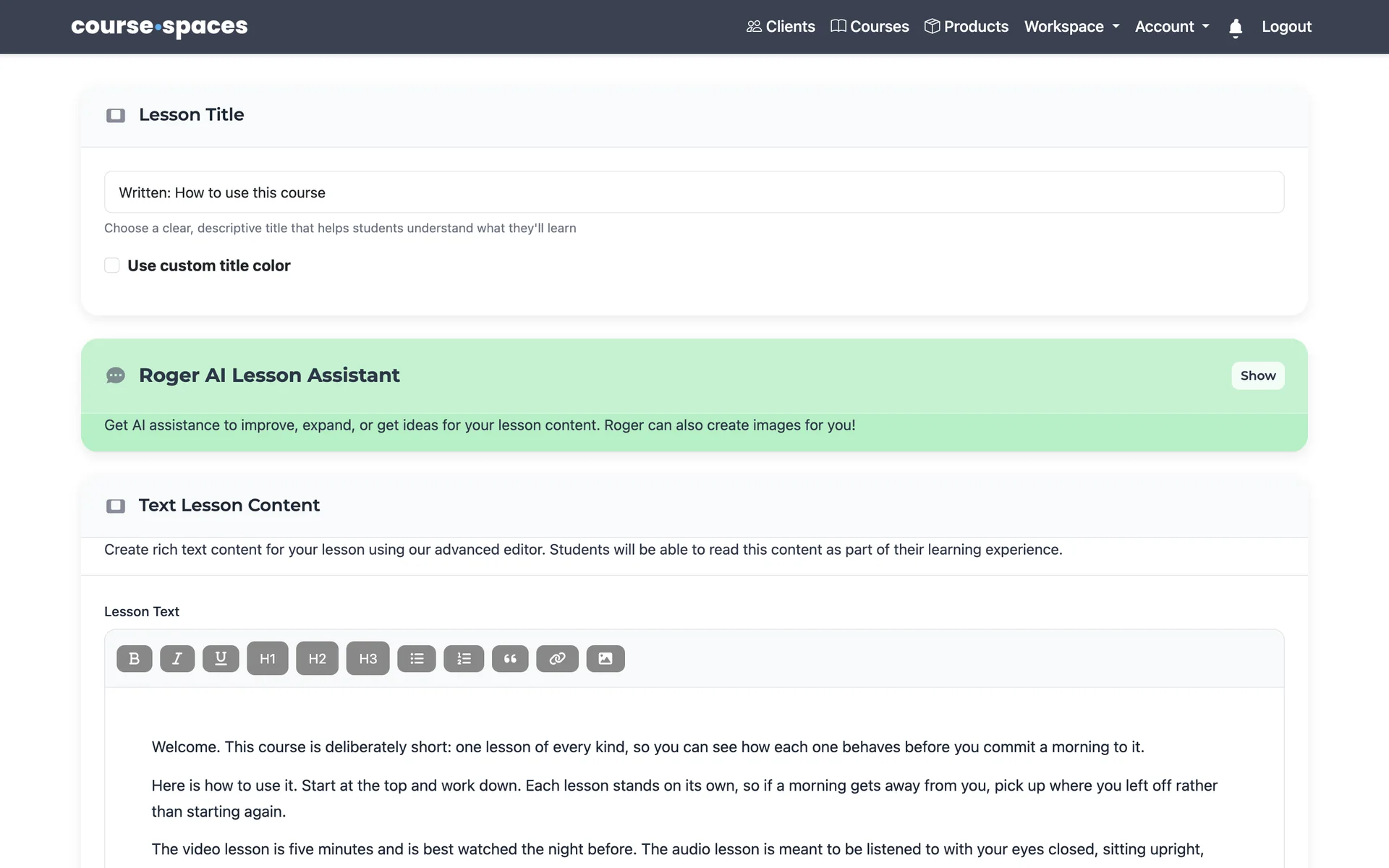
Every lesson the builder wrote opens in a normal editor and you change whatever you want. Rewrite a paragraph, cut a lesson that is padding, rename a section, put your own story where the general advice sits. If a whole section is wrong, delete it and write yours in its place. Nothing is locked, and nothing has to be kept because the AI suggested it. Rename the course itself if the title it picked is wrong, because all of that can be changed later, which is the entire point of a draft. And if a lesson is beyond saving, empty it and start typing.
Lessons don't have to stay as text, either. Add a video, an audio recording, a PDF, a quiz or an assignment you mark by hand, beside the written lessons or in place of one you've deleted. Five minutes of you explaining something in your own voice usually beats a page of prose, and it is quicker to make than rewriting the page would be.
The AI assistant sits at the top of the lesson editor while you work, and the plan includes 1,500 messages a month with it, for the moments you're stuck and want to ask something. None of this asks you to understand what the AI is doing under the bonnet, and if the fear that all of this is too technical for you is the real reason you haven't started, it deserves the ten minutes it takes to read.
Where the time really goes

The draft is the quick part. Your voice is an evening, or two if the course is a long one. The cutting goes fast, because you know the subject better than the draft does and you can see what's missing at a glance. Writing the six or seven paragraphs only you could have written is the slow part, and that's where the evenings go.
People hear how quickly the draft arrives and take the speed for the promise. The promise is smaller and better than that. You never again open an empty course, stare at it, decide that tonight is not the night, and close the laptop. The blank page is the thing that has been beating you, and the blank page is what goes.
An aside that has no work to do here: I have never liked the word "module". Nobody outside software has said "I'm on module three" without sounding like they're filling in a form at a dentist. The builder calls them sections, which is better, and if you'd rather call them weeks or chapters or Part One, rename them and nothing breaks.
When a generated draft is the wrong place to start
- You want a finished course tonight. What arrives is a beginning. If nobody puts your voice into it, it will read like nobody wrote it, and that will be the plain truth.
- You could not correct it line by line. It writes confidently about everything, including the parts it has wrong. On a subject you are still learning yourself, you won't spot them, and your name goes on the page regardless.
- What you teach is contested or regulated. A general draft states things flatly that you would never say to a client without two qualifications around them. Read every line as though your professional body were reading it over your shoulder, because one day somebody will be.
- The lessons already exist as lessons. If twelve weeks of material is sitting in a folder, already split into sessions and in the order you teach it, the builder has no structure left to give you. Build the course by hand and paste your lessons in. One long document is a different case, and getting a written course ready to sell starts with the builder for exactly that reason.
One plan, $47 a month

One flat price, $47 a month, with no tiers to read. It carries the AI course builder, the AI assistant, unlimited courses and products, up to 1,000 active students, hosted video with 1TB of bandwidth a month, communities, chat, a sales page, coupons, graded assignments and a certificate when somebody finishes.
We take 0% of what you sell. You connect your own Stripe account, so you keep everything except Stripe's own 2.9% plus 30 cents.
The trial runs 30 days and it does not ask for a card. Open the builder, describe the course you have been meaning to make since 2024, and read what comes back. Rewrite one section until it sounds like you, then give the course to one client you already see and watch where they stop. If you stay, there's a 30-day money-back guarantee behind it.