

What changes when you turn a course into a monthly membership
A one-off sale asks its question once. Is this worth the money to me. She decides, she pays, and the deciding is over.
A subscription asks the same question every month, in the background, usually on the day the payment leaves her account. Is this still worth it. For a good while she answers yes without noticing she has been asked. Then comes the month she notices.
Whatever answers that question in month four is the thing you are really selling. The course is what got her through the door.
And a course, by itself, can't answer it. Not because yours is thin, but because a course is built to finish. You made it so somebody could start at the beginning, work through, and come out the other side able to do the thing, and if it came out of a subject you have been teaching in a room for years then it is the best asset you own. Finishing is what it is for. A finished thing that renews every month is a strange bargain to be on the paying side of, and people do get round to noticing strange bargains.
Two things while we are still near the top, because they decide who should bother with the rest of this. I have not measured what a room does to cancellations, ours or anybody else's, so there is no figure on this page about renewals and there should not be. And a group of people will not rescue a course nobody wanted. It holds up something that already works.
The month she stops opening it
Weeks one to three she's in there most evenings. By week five she's a lesson behind and telling herself she'll catch up at the weekend. Then there's a whole month where she doesn't open it once, and nothing bad has happened, and she isn't cross with you, and she'd still give your name to a friend who asked.
The payment goes out on the eleventh as usual.
On the second or third of those months she happens to be looking at her statement for another reason, sees your name on a line she hasn't thought about in months, and cancels in about nine seconds. Hardly anybody cancels in a temper. They cancel because the last thing that happened, happened in April.
The uncomfortable part is that this is worst when the course is good. One that somebody bounces off gets cancelled in week two and you barely feel it. One that somebody finishes, gratefully, gets cancelled later, and often with a lovely email attached.
The usual fix is a second job

The standard advice from here is to make something new every month. A fresh module, a masterclass, a downloadable thing, so there's always a reason to still be there.
It works. I would not tell anyone it doesn't.
What it also does is sign you up to a deadline that never ends. Your membership is only ever as alive as the last thing you recorded, and the quiet months are quiet for a reason. December arrives with a cold, a house full of people and a recording owed to fifty of them. You haven't built a membership at all. You have given yourself a monthly commission you can never turn down.
There's a reason it gets taught this way, and it's that nearly all the advice about memberships is borrowed from gyms. A gym's ideal member pays on the first of the month and never comes in. Yours is the precise opposite: the one who stops coming in is the one who cancels in October. Anything that came out of that world will be wrong for you in a way that sounds like good business sense right up until it costs you the person.
What is still happening on a Wednesday
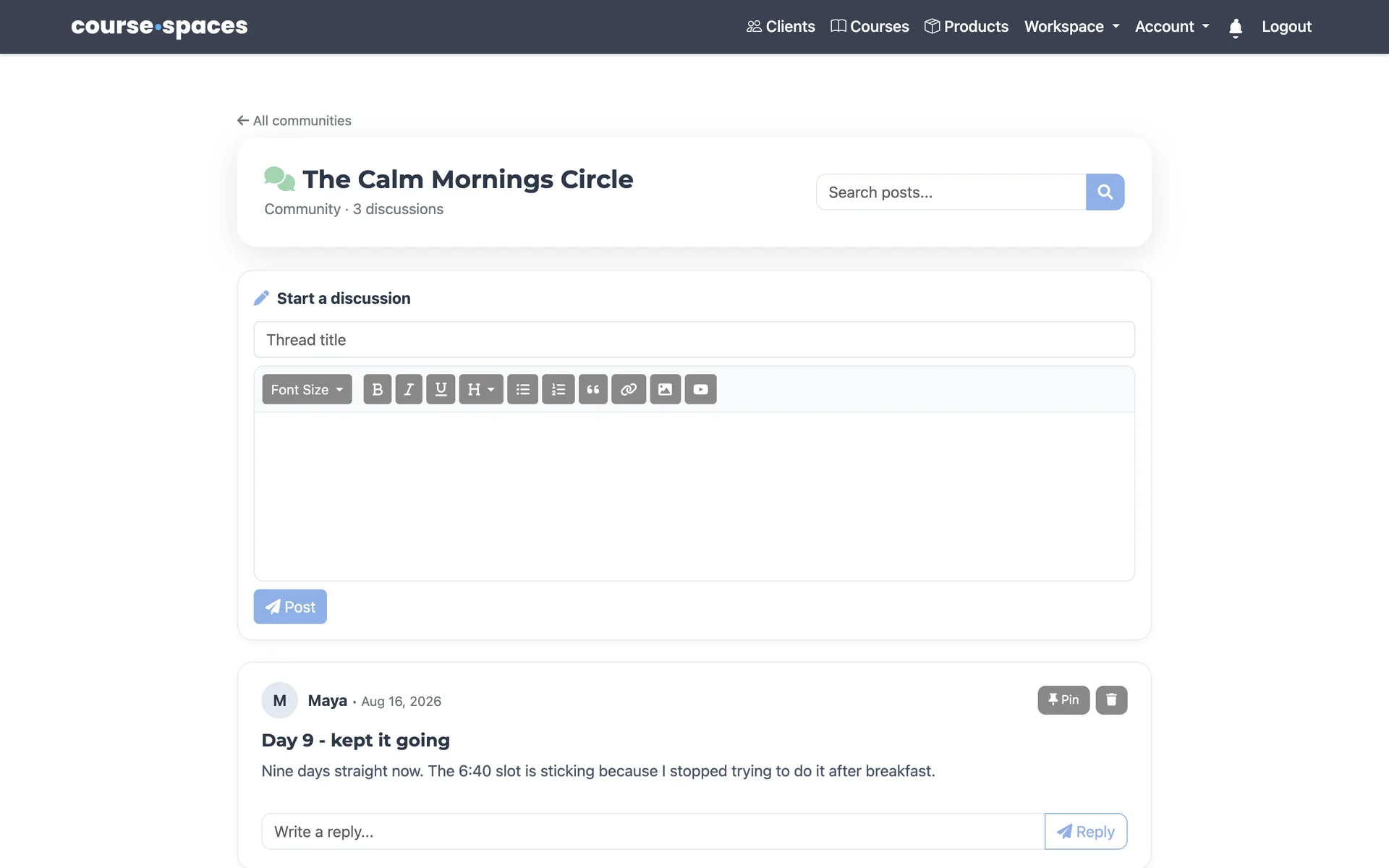
The other thing that can be new this month is the other people.
A room beside your course doesn't need you to record anything in order to be different on Wednesday from how it was on Monday. Somebody posts about what happened the first time she tried it on her own. Two people disagree gently about the order to do things in. Somebody who finished the course back in March is still in there answering, because the room is where her people are now.
For your member in month four, that is the difference between a set of videos she's already watched and a place where something might be going on. She opens it to see.
There's a case for a room made purely on the students' terms, and I've written it out on its own page, because what a group does for the people inside it is a different argument from this one. This page is only about whether the payment keeps going out.
Something with a date on it

Rooms sag when there's nothing ahead of them, so put one thing in the month that has a date.
A live hour, same time each month, set for everyone in the calendar. It doesn't have to be a lesson and it's usually better when it isn't. Questions, whatever came up in the room that week, somebody's problem worked through out loud. What it does is give the month a shape. She isn't cancelling today because there's the thing on the fourteenth, and next month there'll be another fourteenth.
Habit challenges do the same job on a smaller scale if your subject suits them: one small practice, with a daily check-in.
One hour a month is a fraction of the work of a new recording a month. I would rather have the hour.
What the money is attached to

A product can be priced three ways: free, a one-off purchase, or a subscription. Choose the third and a new member gets in straight after paying, without you doing anything by hand. The course sits where it sat, the room sits beside it, and your members log in to one place and see your name and your colours on it.
You don't have to convert the course, either, and I'd think hard before you did. Sell the course once at its own price, and put a smaller monthly price on the room and the sessions alongside it. The people who wanted a course get one and can leave when they're done, pleased with you. The people who wanted somewhere to be get that instead.
When a membership is the wrong shape for you
- What you teach genuinely finishes. Some things are a technique: you learn it, you have it, you're done. Charging monthly for that turns a clean ending into a bill, which is how you take a delighted customer and hand her something to cancel.
- You have four students. A room needs enough people in it that somebody other than you can answer a question. Until then it's a group chat where everyone can see how quiet it is, and the course is the thing to sell first.
- You need this quarter to be bigger than the last one. A monthly price is a small number by design and it takes a lot of months to add up to what a launch does in a week. If something specific has to be paid for in the next few months, sell the course.
- You already run a group somewhere that works. Do not move a working room to tidy up your software. If your question is where a group ought to live, that argument is somewhere else and it is the other half of this page.
Both halves are on the one plan

$47 a month, one plan, no tiers to decode. Unlimited communities and one to one chat are in it, along with unlimited courses and products, up to 1,000 active students, hosted video with 1TB of bandwidth a month, the calendar and appointments, the AI course builder and the AI assistant at 1,500 messages a month.
We take 0% of what you sell. You bring your own Stripe account and keep everything except Stripe's own 2.9% plus 30 cents. The trial runs 30 days and doesn't ask for a card. If you pay and it turns out to be wrong for you, there's a 30-day money-back guarantee.
Here is a small version of this to start with. Put in the course you already have and bring in the people who have already finished it. Open one room, put one date in next month's calendar, and offer that pair at a monthly price to those people only. They know your work, they've got nothing left to work through, and within a fortnight they will have told you whether there is anything here worth building.