

What happens after someone buys your course: the first minute
She pays, and she has access. It happens automatically, straight after the payment goes through. Nobody has to notice the sale, find her email address and send her a link. When she logs in, she sees your name and your colours at the top, and the thing she bought waiting for her.
What "the thing she bought" means depends on how you set it up. A product can be free, a one-time purchase or a subscription. A one-time purchase is usually a course she pays for once. A subscription can carry more than lessons: it can include a community and sessions in your calendar, so what she's paying for each month is somewhere to come back to.
Getting a stranger as far as paying, with the page, the price and the checkout, is the selling half of this, and I won't repeat it here. This page starts where that one stops, with somebody already inside.
That's minute one, and you don't have to do anything for it. Whether she's glad she bought is settled later, in the first evening, the first question and the second week, and those are made of choices you make in advance.
The first evening she opens it

She opens it properly that evening. The first thing she sees is the shape of the course: your sections, and the lessons in each, in the order you put them. A lesson can be written text, a video, audio, a PDF, a quiz or an assignment, so lesson one might be something she reads or a recording she plays while she does the washing up. If her quiet hour happens on the sofa with a phone, she can install the members area on her home screen and open it like an app.
AI features are part of the paid plan, and you turn them on course by course. If you have, she can ask a tutor about the lesson she's reading, and the answer is drawn only from that lesson's text. There are three buttons too: "Explain simply", "Give an example" and "Quiz me". It answers in English, German or Italian, it follows wellness safety rules, and it won't hand her the answers to your quizzes.
What she's really looking for that first evening is where to start. A list of fifteen lessons with no word from you makes a nervous beginner feel behind before she's begun.
A small opinion: don't record a welcome video. Four minutes of you saying hello is four minutes she sits through before she's allowed to begin, and every teacher I know has recorded theirs eleven times and disliked all eleven. Put three short sentences at the top of lesson one: what to do first, how long it takes, and where to ask if she gets stuck.
Day three, and the first question
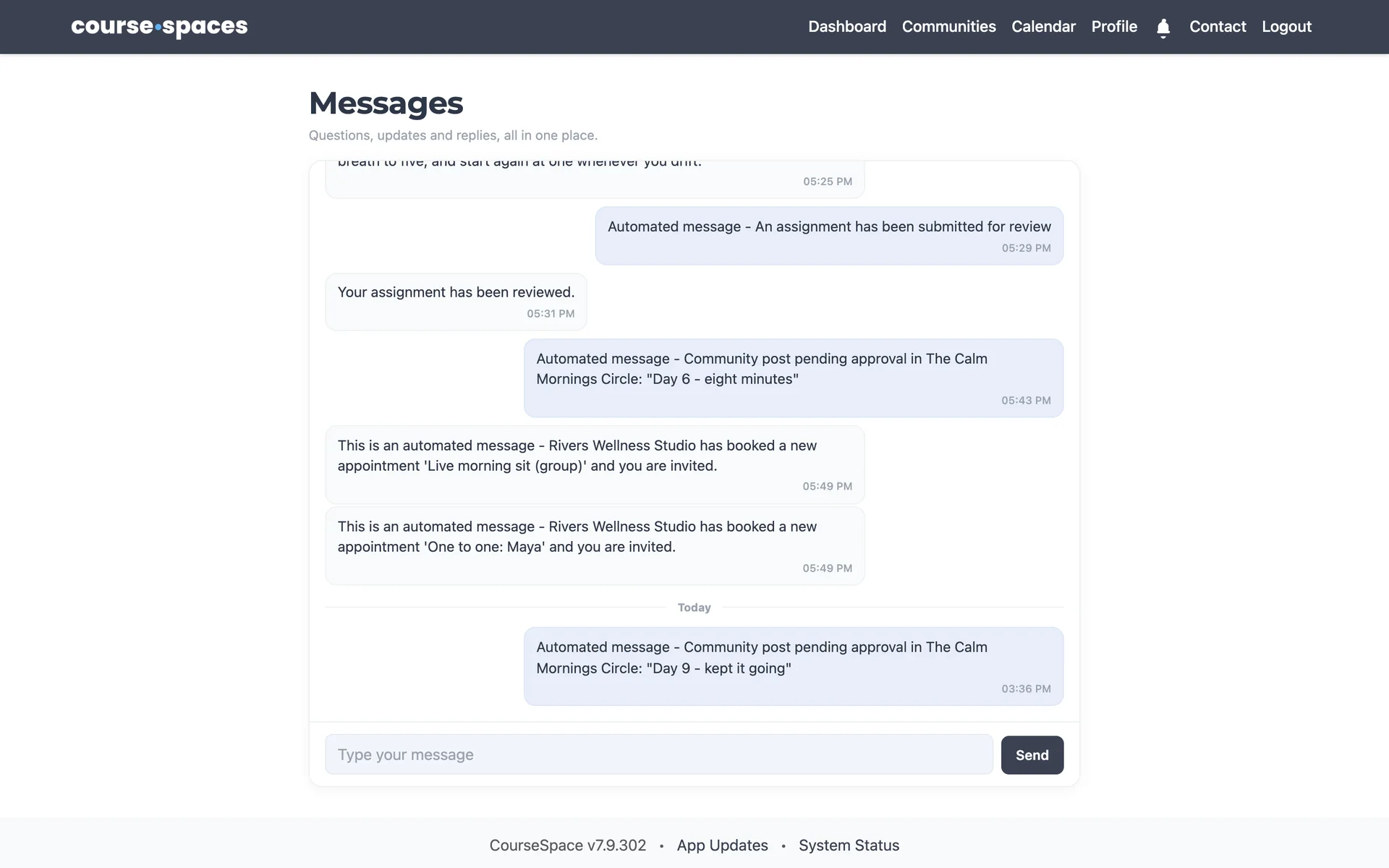
By day three she has a question. In a room she'd have asked it on the way out, holding her coat. Online, it goes wherever she can find you: a message on Instagram, a text to the number on an old flyer. You find it on Saturday, and by then she's decided she was being silly.
So decide where questions go before anybody buys, and say it in those three sentences. Once you've switched chat on, there's one-to-one chat inside the members area, so she messages you from the place she's learning and you reply in the same place. If the course has a community, a question asked there gets answered once where everybody can read it, which helps the next person with the same question.
Either works, as long as it's one and the three sentences say which.
Week two, when she goes quiet
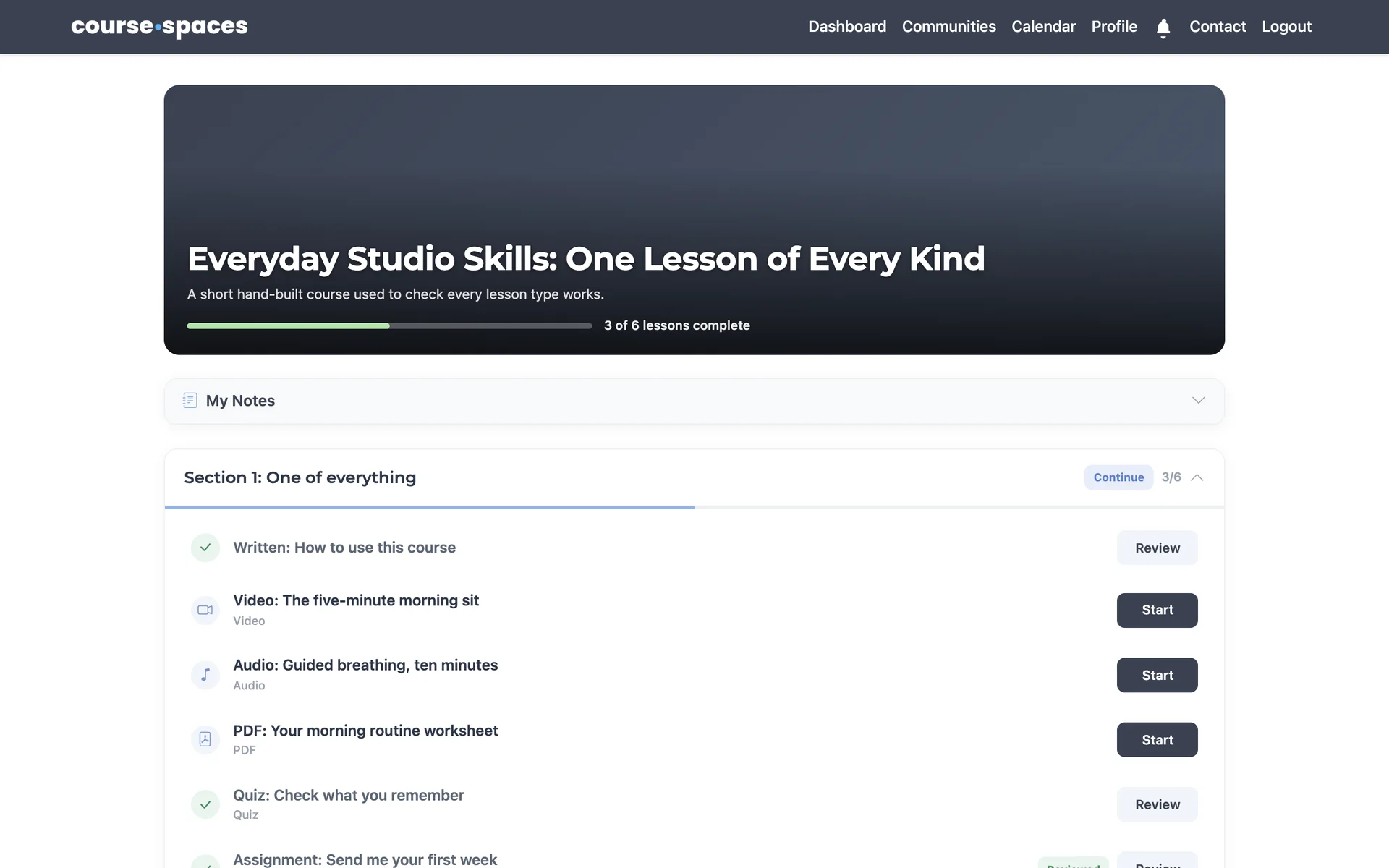
Week two arrives. A child gets a temperature, work gets loud, and the course sits in a tab she keeps meaning to go back to. She doesn't feel she's left. She feels a little behind, and the gap feels wider each day she leaves it. By the time she'd describe herself as having stopped, she's slightly embarrassed to come back. None of this says anything about your teaching.
You can watch, though. As she works she marks lessons complete, and her progress shows on your side. Once a week, look at who's moving and who hasn't marked anything complete since the first weekend, and write to that person by name. Two lines is plenty.
The automatic emails do the rest of the remembering. Each one is set off by something the student does, and you write them once, in your own voice. If quiet students are already your problem on a course you've sold, there's a whole page on why students stop after week two.
If what she bought was a subscription

With a subscription she'll be paying again next month, so the community and the calendar matter as much as the lessons, and she'll look at both on the first night.
Before the first subscriber arrives, make sure the room has something in it and the calendar has a date in it. An empty room and a blank month tell her more on day one than your sales page ever did. Two dates in the first month is plenty, and so is one post from you asking a real question.
Why a monthly price depends on that room and those dates is an argument of its own, and it's the other half of this section.
Telling everyone at once
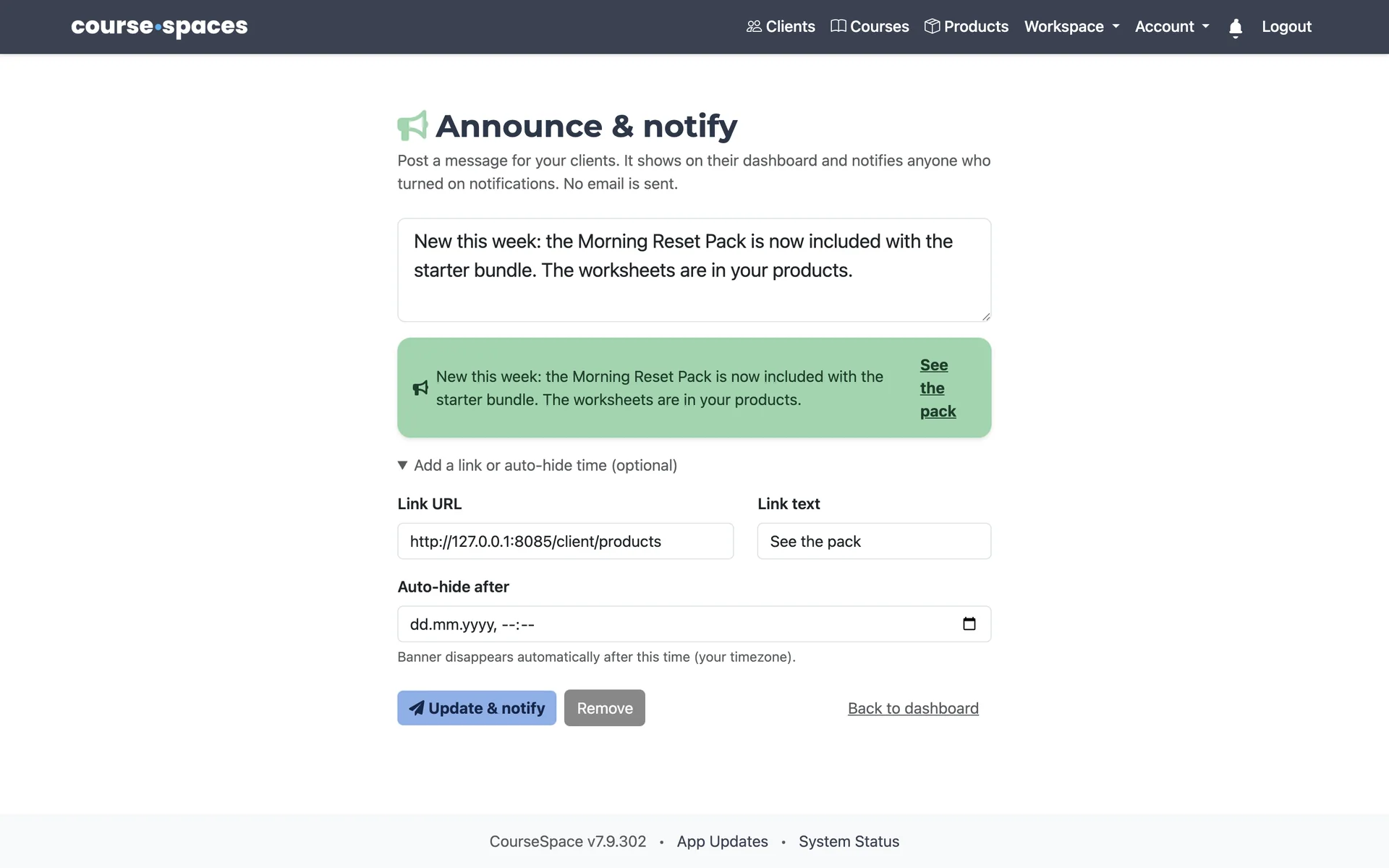
Some things are for everybody: the session moved to Thursday, the week you're away. An announcement is a message, with a link if you want one, and an expiry date. It sits on every client's dashboard until that date, then it's gone. For anything that can't wait until she logs in, email broadcasts go straight to her inbox.
Your checklist before the first buyer arrives

1. Give the course to yourself. Add yourself as a client with a second email address, free of charge, and log in as her. 2. Open lesson one on your phone, standing up, the way she will on the train. 3. Write the three sentences at the top of lesson one: what to do first, how long it takes, where to ask. 4. Pick one place for questions, and make it the one those sentences name. 5. Write the automatic emails in your own voice. 6. Put half an hour in your diary each week to look at progress. 7. If it's a subscription, put one session in the calendar and one post in the community first.
When you can skip most of this
- You sell a single download. A recording somebody buys once and plays when she needs it has no second week. Get the access right and leave the rest.
- You were hoping something else would answer the questions. The tutor answers about the lesson in front of her. On day three, the person she wants to hear from is still you.
- Your buyers already meet somewhere that works. If there's a group they turn up to happily, leave it there and point the course at it.
Everything above, for $47 a month

One plan, $47 a month, no tiers to decode. It covers up to 1,000 active students, unlimited courses and products, hosted video with 1TB of bandwidth a month, and $10 per TB beyond that. Unlimited communities and chat are in it, with the calendar, the automatic emails, the AI course builder and the AI assistant at 1,500 messages a month.
You bring your own Stripe account. We take 0% of what you sell, and Stripe takes its own 2.9% plus 30 cents. The trial runs for 30 days and doesn't ask for a card, and if you pay and it turns out to be wrong for you, there's a 30-day money-back guarantee.
Do the first thing on that checklist tonight, before you tell anyone the course exists, and spend one evening being her. You'll find the two things you'd change within a quarter of an hour.